One Front Door for Every Invitation: Booking Requests in Two Languages
A worship leader's system for booking requests: one form for every invitation, questions that end the back and forth, two languages, written confirmation.

By Elizabet Maria, Worshipper, Minister and Singer-Songwriter.
Edited by ROEM Digital.
Disclosure. Elizabet Maria Ministries is a ROEM Digital client, and ROEM helped prepare this post.
Short answer: If organizations book you for dates, give every request one front door: a single form that asks the questions you would otherwise chase by message, in every language your clients use. Publish what you need before anyone asks, and treat nothing as booked until it is confirmed in writing.
Getting booked is part of the work, even in ministry
I'm a Worshipper, an ordained Minister and a singer-songwriter. Churches and ministries invite me to lead worship at services, worship nights, conferences, camps and retreats, in Spanish and in English. Every invitation comes straight to me, not to a middleman, and I answer each one myself.
Every opportunity to serve is a great honor for me. It's also a request with a date, a place and a lot of details attached. If clients book you for a day, as a photographer, speaker, caterer or musician, you know the feeling: the work only happens if the booking goes right.
This is how I handle invitations. The details are mine, but the system works for any business that gets booked.
Give every request one front door
Every invitation I receive goes through one form. People can follow me on Instagram, Facebook and YouTube, and I love hearing from them there. But an invitation goes through the form, and my website says so in plain words.
A message in an app is easy to send and just as easy to lose, and it rarely includes the date, the address and the name of the person organizing. A form puts every request in one place, with the same answers in the same order, so nothing depends on my memory.
Three things make a single front door work:
- Put it where people look first. My invitation form sits near the top of my home page, right under my name, and again near the top of my invitations page. We moved it up because people kept messaging me when they couldn't find it.
- Keep one list behind it. I had my own form before I had a website. When the website got its own version, it was set up to send answers into the same list as the original, so I still work from one place, not two.
- Always offer a backup. Right under the form on my site there's a link to the same form in a second place, in case the first one gives someone trouble.
If a request still arrives as a direct message, the kindest reply is a warm thank you and the link. The organizer gets a clear next step, and you get every detail in writing.
Ask the questions you'd otherwise chase by message
The best booking form is a list of every follow-up question you've ever had to ask, answered before you ask it. Mine opens with a short greeting that thanks the person for the invitation, then asks for:
- Who is organizing: the coordinator's name, phone number and email, the names of the pastors and the name of the church.
- The event itself: its name, date and time, the country and state, and the full address.
- What kind of gathering it is: a conference, a worship night, worship during a regular service, a camp, a concert, a retreat or a congress, plus who it's for: adults, women, youth, younger youth or everyone.
- What my part is: whether I'll lead worship or have a special part, and roughly what time I'll go up.
- What's already there: whether a band will be provided.
- Anything else: the theme, the schedule or anything I should know, in a sentence or two.
Notice how many of those are choices rather than blank boxes. A list of event types is quicker to answer than an open question, and the answers come back in words I can sort and compare. Save the open box for the things only the organizer can tell you.
Every question on my form is required, and it still takes about three minutes. I wanted it easy enough that nobody could get it wrong, and the answer wasn't fewer questions. On my website the form has two steps: everything you type first, like names, dates and the address, then everything you choose, like the type of event. A one-line hint sits under the questions where people tend to pause, such as “An estimate is fine” under the time I go up.
| Question | Why it earns its place |
|---|---|
| Who is coordinating, and how do I reach them? | The person who fills out the form is often not the person in charge. You need someone who can answer your questions. |
| What is the exact date, time and address? | A city is not an address, and “Saturday night” is not a time. Exact answers let you check your calendar right away. |
| What kind of event is it, and who is it for? | The same service looks different at a youth camp and at a women's conference. The answer shapes how you prepare. |
| What will already be there? | Equipment, staff or musicians on site change what you need to bring. |
Publish what you need before anyone has to ask
My form gathers what I need to know about the event. My invitations page answers what the organizer needs to know about me, before they fill anything out. It covers the kinds of gatherings I serve, from Sunday services and worship nights to conferences, retreats and street evangelism, and two practical things:
- How far I travel: worldwide. Inside the United States I travel with one guest, and outside it with one guest and one security escort.
- What I need from the host: ideally a band with piano, drums, guitar and bass. I also sing to tracks if the church provides them, and I bring my own tracks for my own songs.
The line I'd most encourage you to copy is the one that says what's flexible. Mine says that if a church doesn't have every musician, that's fine, because I've Ministered without a band in small churches. Without that sentence, a small church with one guitarist might read “piano, drums, guitar and bass” and never write at all. Requirements written only as rules can quietly turn away the very people you'd be glad to serve.
Your version might be your service area, your setup needs or how much notice you need. Put it in plain words on the page people read before they contact you, and say where there's room to bend.
Serve two languages with one form, not two
I Minister in Spanish and in English, and so do many of the churches that invite me. My form was written that way from the start. Every heading, question and option carries both languages side by side, so “Nombre del Coordinador | Name of Coordinator” is one question, not two. Even the greeting at the top is written twice, once in each language.
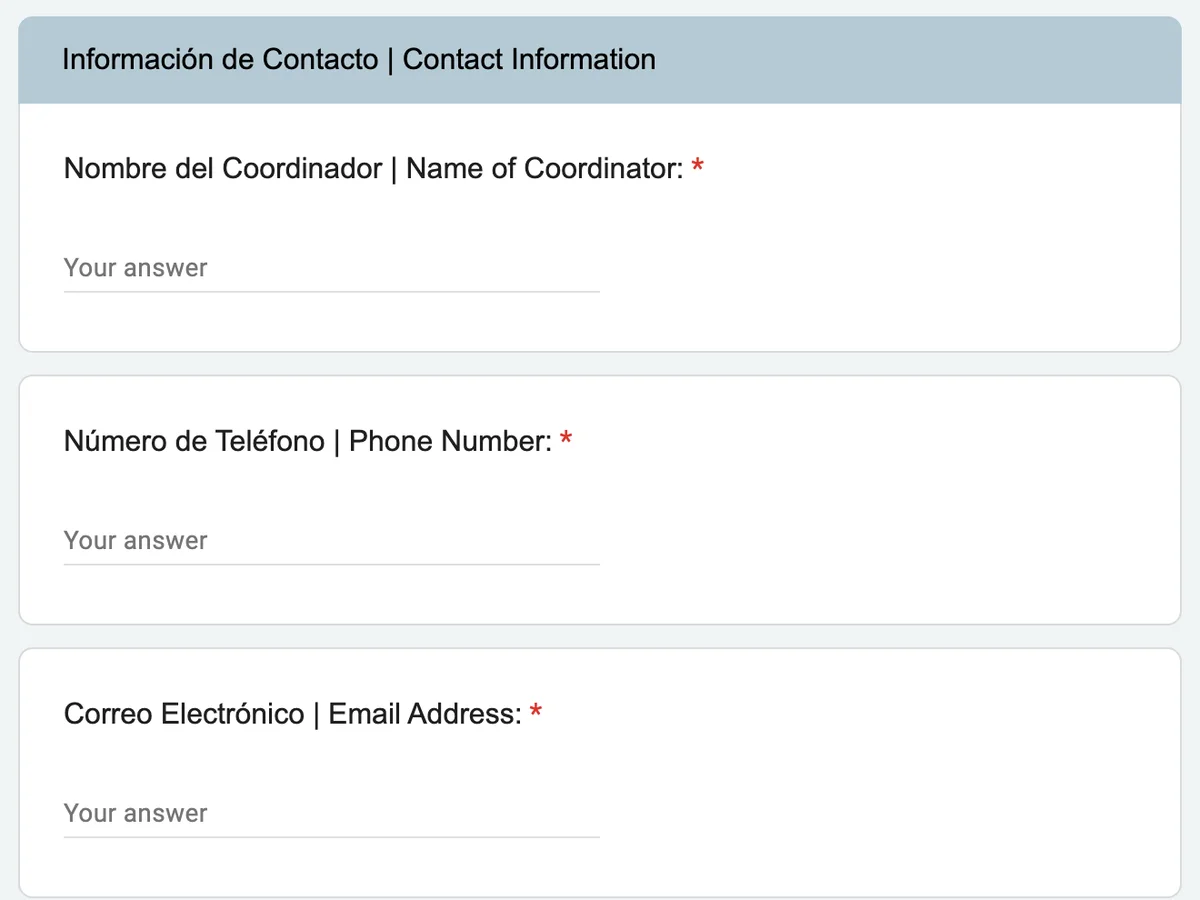
That choice does three things. A bilingual coordinator and a pastor who prefers Spanish can both read the same form. Every answer lands in the same list, whatever language it was written in. And I never have to keep two inboxes in step.
My website has full Spanish and English versions of every page, and the form in each language feeds that same list. My original form also asks one question I'd recommend to anyone who serves two languages: is the event in Spanish, in English or bilingual? If you serve customers in two languages, resist the urge to build a separate Spanish form that sends to a separate place. Two forms become two lists, and sooner or later one of them goes unread.
Nothing is booked until it's confirmed in writing
My invitations page says it plainly: no date is held until I confirm it in writing. Sending the form is a request, not a booking. I reply within a few days to talk about the date, and I ask organizers to wait for that written confirmation before they announce anything.
That rule protects both of us. An organizer who prints a flyer with my name on it for a date I never agreed to has a hard conversation ahead. Putting the rule on the website, where it's read before the form, means nobody is surprised by it later.
Two habits make it work for any business:
- Publish your reply time. Mine is “within a few days.” A stated window keeps people from wondering whether their request arrived.
- Use the same steps every time. Request, then reply, then written confirmation. When the steps never change, the people who book you learn them, and so does anyone who helps you.
A checklist for your own booking requests
You don't need to lead worship to use any of this. Try the short version this week:
- Pick one front door for every booking request, and link to it from every profile you have.
- Turn your usual follow-up questions into form questions, with choices wherever you can.
- Publish your requirements in plain words, including the ones that bend.
- If you serve two languages, put both on one form that feeds one list.
- State your reply time, and treat nothing as booked until it's confirmed in writing.
Every invitation deserves a clear answer. A front door that's easy to find and easy to finish is how I try to honor the people who invite me. It can do the same for the people who book you.
Frequently asked questions
Should I accept booking requests through social media messages?
You can welcome people there, but move the booking itself to one form. Messages scatter across apps and rarely include the date, address and contact details you need. A friendly reply with the link gives the person a clear next step.
How many questions should a booking form ask?
As many as you need to reply without a follow-up, and no more. Required questions are fine if the form is quick to finish. Use short steps, choices instead of blank boxes, and a one-line hint where people tend to pause.
How do I take booking requests in two languages?
Use one form with both languages on every question and option, or one version per language that sends answers to the same place. Either way, keep a single list of requests, and ask which language the event or job will be in.
When should I treat a booking as confirmed?
Only after you confirm it in writing. Say on your website that a request is not a booking, and ask clients not to announce the date until they have your written confirmation.
Guest posts share the author's own experience and views. ROEM Digital edits them for clarity and accuracy.